
What is ETH Worth?
13 valuation lenses, two composites, and a conviction that ETH remains misunderstood and mispriced.
Over the last six months, I have spent a lot of time thinking about how to value ETH, updating my priors and re-underwriting our investment.
There is no textbook on this stuff, you won’t find the answer in Ben Graham’s Securities Analysis or Frank Fabozzi’s Fixed Income Handbook.
ETH is a truly novel asset.
It is the native money of the Ethereum network, and it is unique because it possesses qualities of both a commodity and a capital asset, something I am yet to identify elsewhere.
As a commodity, ETH is consumed every time a transaction is processed, a loan is issued, or an exchange is settled. Every time a user requires validity and finality for a transaction of value, ETH is consumed. As a commodity, ETH has a stock-to-flow ratio of 67 at maximum issuance, placing it squarely in gold’s range of 60-70 and far above oil’s sub-1 ratio.
As a capital asset, ETH can be staked to earn a yield. But staking is not merely a return mechanism. As the native asset of a proof-of-stake network, ETH serves as the economic security layer of Ethereum itself. Validators must stake ETH as collateral to participate in consensus, and for that security mechanism to be meaningful, ETH must hold real value. A network secured by worthless collateral is no network at all.
This creates a reflexive relationship where the utility Ethereum provides depends on the security ETH underwrites, and that security depends on ETH retaining value. This duality, and this reflexivity, creates real confusion around how ETH should be valued.
I have tried my best to take a position as a judge in the keynesian beauty contest taking into consideration how each of the millions of judges around the world may choose to value ETH.
Some may value ETH as the discounted sum of its future cashflows, like they would value a share in a business. Some may value it using Metcalfe’s law, attempting to estimate the value of ETH’s network effects. Some choose to value it like an economy assessing what it secures in on chain asset value and application capital. Others value ETH as money or a currency by applying the equation of exchange.
Through this process I have identified 13 independent valuation lenses which are used by market participants across the market. I have summarised these findings in the ETH valuation dashboard.
For each of the valuation approaches, I provide the underlying formula, a breakdown of the inputs used, and links to relevant academic research and articles that you can use to draw your own conclusions.
Taking the average across the 13 models, I have constructed the neutral composite which weights equally all of the valuation approaches identified.
I also offer up a highly opinionated way of thinking about ETH’s valuation, the Etherbridge ETH composite. As I don’t think that all of these valuation models are equally applicable to the unique asset that is ETH.
For example valuing ETH as a share of the company “Ethereum”, to me is fundamentally flawed. Ethereum is a network which will operate most effectively by extracting minimally. Valuing ETH as a function of what Ethereum extracts from users and application developers is backward. It’s an attempt to put something new and unique into a familiar but completely inappropriate bucket.
The Etherbridge ETH composite combines six different models that I believe best capture ETH’s intrinsic value drivers: the capital that it secures, the non-linear growth of its network, its full ecosystem including its layer twos, real-world demand for its block space and the monetary value flowing through it.
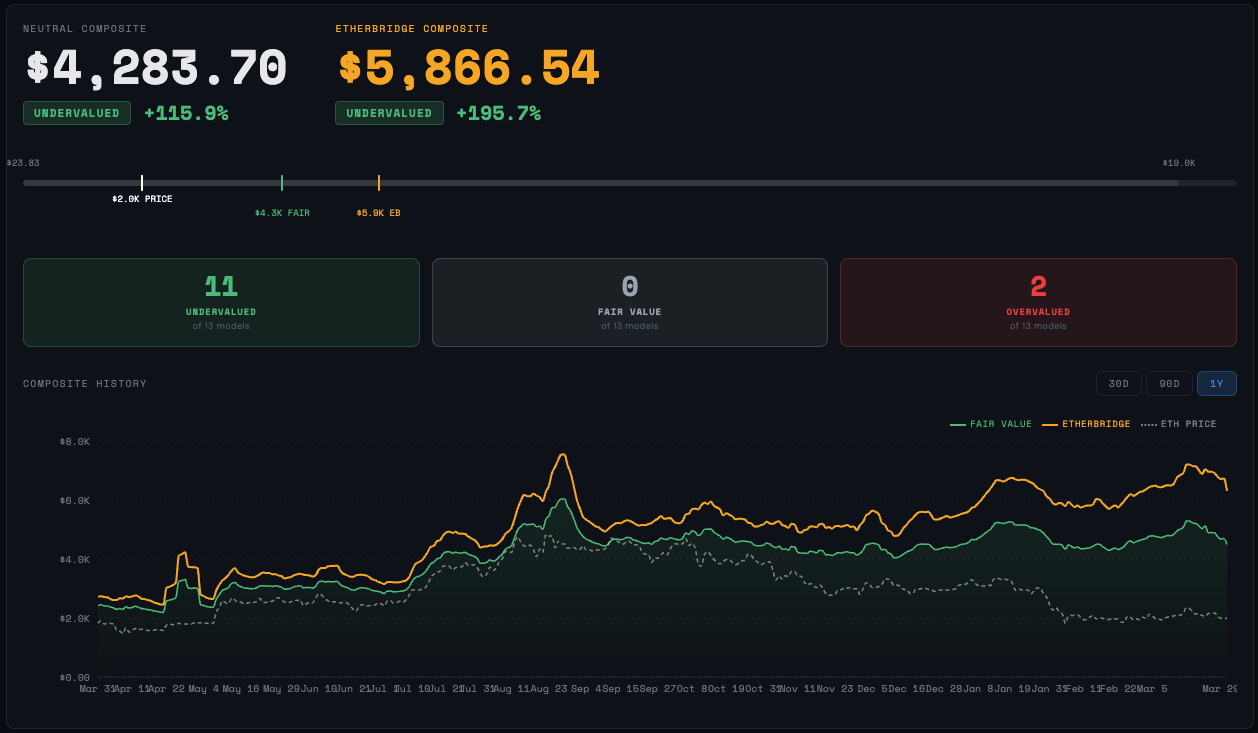
The equally weighted neutral composite values ETH at $4.2k, 115% more than its current value, the Etherbridge ETH composite comes in at $5.8k, 195% above its current value.
I’ve come away from this period of price pain and deep thinking even more convinced that the world is under-appreciating ETH and that it is mispriced at $2,000.
The dashboard is yours to interrogate and I encourage you to explore each valuation lens and come to your own conclusions.
While it’s easier to look away, seeking to understand is the only path to a more enlightened and empowered world. Change is now exponential and blockchain technology sits at the center transforming money, finance and what it means to be sovereign. Join me in exploring this new world by subscribing.

This is not financial advice. All opinions expressed here are our own. We encourage investors to do their own research before making any investments. Collective Investment Schemes (CIS) are generally medium to long term investments. The value of participatory interests may go down as well as up. Past performance, forecasts or commentary is not necessarily a guide to future performance. As neither Lima Capital LLC nor its representatives did a full needs analysis in respect of a particular investor, the investor understands that there may be limitations on the appropriateness of any information in this document with regard to the investor’s unique objectives, financial situation and particular needs. The information and content of this document are intended to be for information purposes only and should not be construed as advice.